About the original paper
Michael Ku, Megan J. Ramos, and Jason Fung published Therapeutic fasting as a potential effective treatment for type 2 diabetes: A 4-month case study in the Journal of Insulin Resistance in December 2017. The original paper is available in full at the publisher’s site at journalofmetabolichealth.org under a Creative Commons Attribution 4.0 license.
The patient was a 69-year-old man treated at the Intensive Dietary Management Clinic in Scarborough, Ontario, over four months. His regimen started with 24-hour fasts three times a week. It progressed to 42-hour fasts two or three times a week.
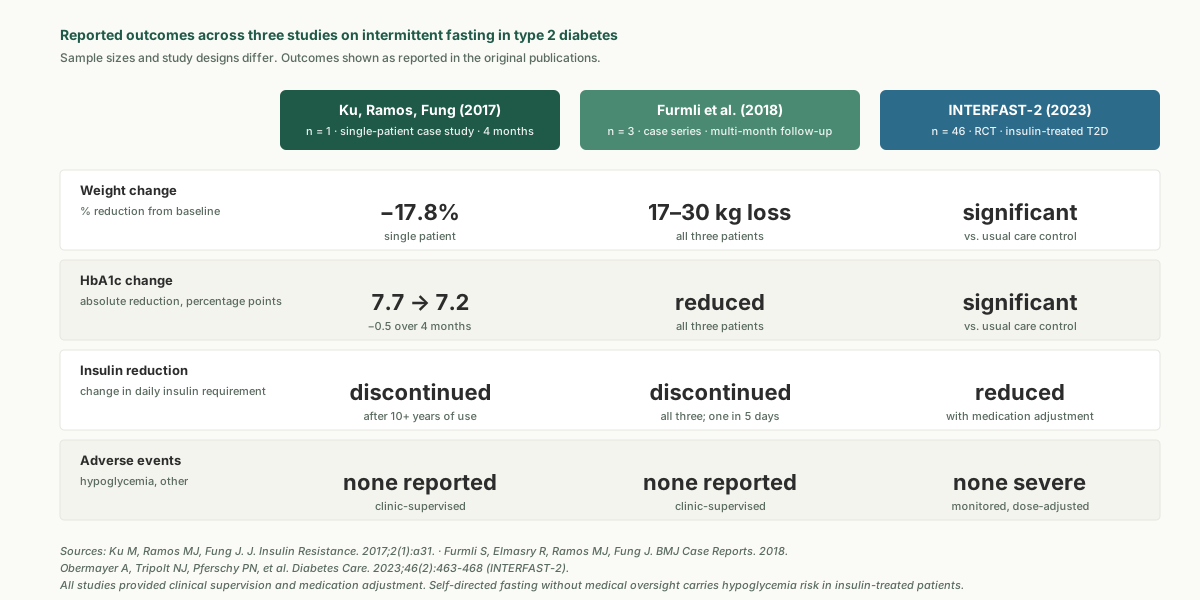
The outcomes were specific. Body weight dropped 17.8%. Waist circumference dropped 11.0%. HbA1c fell from 7.7% to 7.2%. The patient discontinued insulin completely, after more than ten years of daily injections. No hypoglycemic episodes occurred. No significant adverse effects were reported.
The authors framed therapeutic fasting as a viable treatment option. They also named the limitations: a single patient, no controls, observational design, and a clinic that provides intensive supervision unlike the conditions most patients would encounter outside a research setting.
The paper did not declare external funding. Ramos and Fung are affiliated with the Intensive Dietary Management program. Fung has also published popular books advocating fasting for metabolic disease. These affiliations are worth knowing when reading the case. They do not invalidate the clinical observations, which are reported in detail.
The article has accumulated more than 107,000 views. It has been cited five times in subsequent peer-reviewed work, including studies on intermittent fasting in T2D, Ramadan fasting outcomes, and the pathophysiology of T2D remission.
What has been validated since publication
The core claim is that some patients with type 2 diabetes can reduce or eliminate diabetes medications, including insulin, through structured dietary intervention. Between 2017 and 2026, that claim has gained substantial support.
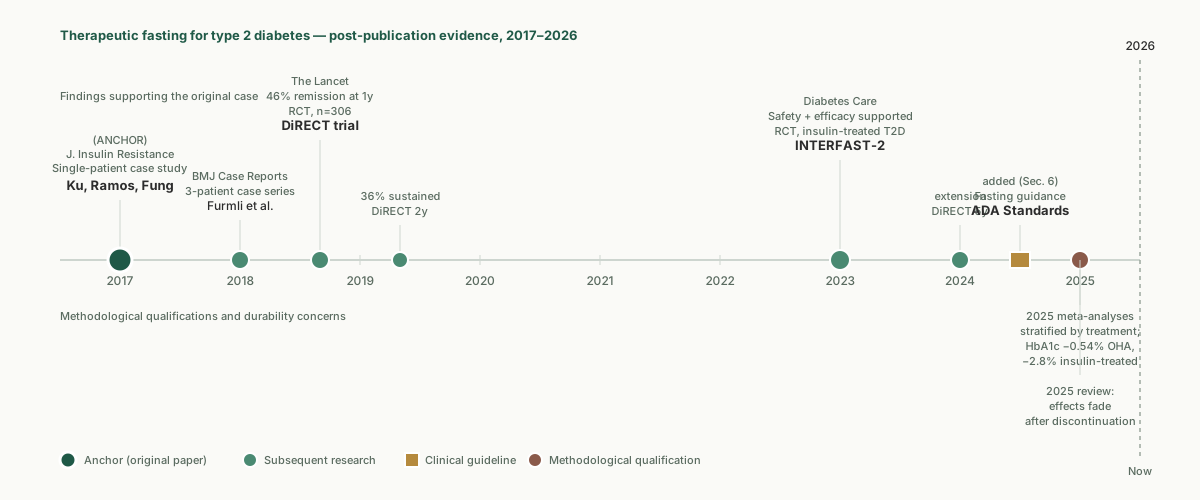
The same group published a follow-up case series in BMJ Case Reports in 2018 (Furmli, Elmasry, Ramos, Fung). Three additional men, aged 40 to 67, all on at least 70 units of insulin a day, used a 24-hour fasting protocol under clinic supervision. All three discontinued insulin within the observation period. One stopped within five days. All three lost significant weight, reduced waist circumference, and reduced HbA1c.
The DiRECT trial in The Lancet in 2018 took the broader claim and tested it. Primary care–led, cluster-randomized, open-label, 306 participants. At 12 months, 46% of the intervention group achieved diabetes remission, defined as HbA1c below 6.5% without diabetes medications. At 24 months, sustained remission was 36%. The 5-year follow-up in The Lancet Diabetes & Endocrinology in 2024 found that remission was durable for a substantial subset of participants, tracking closely with sustained weight loss.
INTERFAST-2 was the trial the original case could not be. Published in Diabetes Care in 2023, it randomized 46 insulin-treated T2D patients to intermittent fasting or usual care. The fasting group achieved significant reductions in HbA1c and body weight. Adverse events were monitored and managed via medication adjustments and continuous glucose monitoring. No severe hypoglycemia attributable to the protocol was reported.
Multiple systematic reviews and meta-analyses from 2024 and 2025 have synthesized the IF-in-T2D literature. A 2025 meta-analysis confirmed that intermittent fasting outperforms usual care for fasting glucose, HbA1c, and body weight in T2D. A separate 2025 analysis stratified by treatment type and found HbA1c reductions of 0.54% in patients on oral hypoglycemic agents versus 2.8% in patients on insulin. Insulin-treated patients, the population the original case study focused on, may experience the larger benefit.
The 2025 ADA Standards of Care now address fasting directly. Section 6 includes specific guidance on medication adjustments for patients who fast for religious or therapeutic reasons. Therapeutic fasting has moved from fringe approach to a clinical option worth professional guidance.
What has been criticized or remains contested
Single-patient case studies do not establish causality. The 2017 paper is a careful observation of one patient at one clinic. The authors say so in their limitations. Subsequent RCTs and the DiRECT trial have addressed this directly. The original paper, on its own, does not constitute strong evidence.
Durability after discontinuation is unclear. A 2025 systematic review in a clinical nutrition journal concluded that the metabolic effects of intermittent fasting in T2D exist in the short term and disappear after the protocol stops. The implication: fasting works for as long as it is practiced. Long-term remission likely requires sustained dietary change rather than a time-bounded intervention. The DiRECT 5-year data points the same way. Remission durability tracks with sustained weight loss. Weight regain associates with relapse.
Intermittent fasting may not outperform other dietary approaches. A 2024 meta-analysis found that intermittent fasting and continuous calorie restriction produced comparable HbA1c reductions in some T2D populations. The mechanism appears to be primarily about energy restriction and resulting weight loss rather than something unique to the fasting pattern. Patients who can sustain a daily calorie-restricted diet may achieve similar metabolic benefits without the specific fasting schedule.
Hypoglycemia risk in insulin-treated patients is real. The 2017 case reported no episodes, but that patient was managed inside the Intensive Dietary Management Clinic with close supervision. The 2018 follow-up series, INTERFAST-2, and the 2025 ADA Standards converge on the same protocol: medication adjustment before initiating fasting, ongoing monitoring (increasingly with continuous glucose monitoring), and a written sick-day and hypoglycemia plan. The 2025 ADA guidance recommends basal insulin dose reduction before fasting begins — roughly half in well-controlled patients, a third in less-controlled patients. Patients who self-direct fasting without these adjustments face real risk of severe hypoglycemia.
Real-world adherence is lower than in clinical studies. The Intensive Dietary Management Clinic provides coaching, regular check-ins, and a peer community. Outside that setting, sustaining 42-hour fasts two or three times a week is hard. Most studies of self-directed fasting show substantial dropout.
The claim that hyperinsulinemia is the root cause of type 2 diabetes — argued in the foundational JIR editorial by Fung and Berger in 2016 and across Fung’s popular books — remains contested within metabolic medicine. The clinical observation that fasting can reverse T2D in some patients is on solid ground. The mechanistic framing of hyperinsulinemia as the driving pathology, and what that implies for treatment philosophy, is disputed in the endocrinology literature.
What this means for readers in 2026
The central observation has held up. The supporting framework around it has been refined.
If you have insulin-dependent type 2 diabetes and are considering intermittent fasting, the evidence supports that this can work. Many patients have reduced or eliminated insulin through structured fasting protocols. The 2025 ADA Standards of Care give physicians specific guidance on safe medication adjustment. The most important practical point is simple: do not attempt this without working with your prescribing physician to adjust your insulin and other diabetes medications before starting. Severe hypoglycemia is a real risk. It can be life-threatening if ignored. It is also straightforward to mitigate with proper medication adjustment and monitoring. Continuous glucose monitoring is increasingly accessible, and current guidelines recommend it for anyone on insulin attempting any structured dietary intervention.
If you have type 2 diabetes treated only with oral medications like metformin, the hypoglycemia risk is lower but not zero. Metformin alone rarely causes hypoglycemia even during fasting. Combination regimens that include sulfonylureas (glipizide, glyburide) do. Discuss your medication list with your physician before starting any structured fasting protocol.
If you have prediabetes or are considering intermittent fasting for general metabolic health rather than T2D remission, the case study and its follow-up do not apply to your situation as directly. The DiRECT trial framework and the wider literature on weight loss for metabolic health are more relevant. Intermittent fasting is one tool. The evidence does not establish it as clearly better than consistent moderate caloric restriction. Sustainability and personal fit matter more than the specific schedule.
If you have a history of eating disorders, are pregnant or breastfeeding, have type 1 diabetes, or are taking medications that require food intake, intermittent fasting is generally not appropriate for you. Talk with your physician about other approaches to metabolic health.
Type 2 diabetes was framed for decades as a progressive chronic disease requiring escalating pharmacotherapy. The Ku, Ramos, and Fung case study was one of the earliest clinical documents arguing for a different framing: T2D is sometimes reversible through metabolic intervention. The DiRECT trial, the GLP-1 era, the routine use of metabolic surgery for some patients, and the integration of structured dietary intervention into ADA guidance have all moved the clinical consensus in that direction over eight years. The 2017 paper documented a single case at the start of that shift. The broader claim it implied is now closer to mainstream than fringe.
References
- Ku M, Ramos MJ, Fung J. Therapeutic fasting as a potential effective treatment for type 2 diabetes: A 4-month case study. Journal of Insulin Resistance (now Journal of Metabolic Health). 2017;2(1):a31. DOI: 10.4102/jir.v2i1.31
- Furmli S, Elmasry R, Ramos MJ, Fung J. Therapeutic use of intermittent fasting for people with type 2 diabetes as an alternative to insulin. BMJ Case Reports. 2018. PMID: 30301822
- Lean MEJ, Leslie WS, Barnes AC, et al. Primary care-led weight management for remission of type 2 diabetes (DiRECT): an open-label, cluster-randomised trial. The Lancet. 2018;391(10120):541-551.
- Lean MEJ, Leslie WS, Barnes AC, et al. Durability of a primary care-led weight-management intervention for remission of type 2 diabetes: 2-year results of the DiRECT open-label, cluster-randomised trial. The Lancet Diabetes & Endocrinology. 2019;7(5):344-355.
- Thom G, Messow CM, Leslie WS, et al. 5-year follow-up of the randomised Diabetes Remission Clinical Trial (DiRECT) of continued support for weight loss maintenance in the UK: an extension study. The Lancet Diabetes & Endocrinology. 2024.
- Obermayer A, Tripolt NJ, Pferschy PN, et al. Efficacy and Safety of Intermittent Fasting in People With Insulin-Treated Type 2 Diabetes (INTERFAST-2) — A Randomized Controlled Trial. Diabetes Care. 2023;46(2):463-468.
- ElSayed NA, Aleppo G, Bannuru RR, et al. 6. Glycemic Goals and Hypoglycemia: Standards of Care in Diabetes—2025. Diabetes Care. 2025;48(Suppl 1):S128-S145.
- American Diabetes Association. Type 2 Diabetes Remission: A Systematic Review and Meta-analysis of Nonsurgical Randomized Controlled Trials. Diabetes Care. 2025;48(12):2181.