About the original paper
James J. DiNicolantonio and James H. O’Keefe (2023) published Sodium restriction and insulin resistance: A review of 23 clinical trials in the Journal of Metabolic Health. The paper is available in full at the publisher’s site under a Creative Commons Attribution 4.0 license. Both authors are affiliated with the Department of Preventive Cardiology at Saint Luke’s Mid America Heart Institute in Kansas City.
The review searched PubMed using the terms “sodium,” “insulin,” and “insulin resistance” and identified 23 human clinical studies of low-salt diets reporting effects on insulin sensitivity, fasting glucose, fasting insulin, or oral glucose tolerance test responses. The authors framed the findings as collectively supporting the conclusion that “low-salt diets lead to systemic or vascular insulin resistance, glucose intolerance, elevated fasting insulin and/or elevations in glucose and/or insulin levels after an oral glucose tolerance test.”
The review’s conclusion stated: “Caution is advised when recommending salt restriction for blood pressure control as this may lead to worsening insulin resistance.” The paper recommended against routine population-level sodium reduction strategies, particularly for patients with established or developing insulin resistance.
The author group’s broader public profile is relevant context. James DiNicolantonio has authored books advocating contrarian nutrition positions, including The Salt Fix (2017), which argues that conventional sodium guidance is harmful and that higher sodium intake may benefit health. James H. O’Keefe is a clinical cardiologist with substantial public output on nutrition and cardiovascular health. The Saint Luke’s Mid America Heart Institute affiliation lends institutional credibility to both authors’ clinical work. The broader public-profile pattern places DiNicolantonio in the category of authors whose specific peer-reviewed claims warrant evaluation alongside the broader rhetorical framing the same authors deploy in books, podcasts, and other media.
The paper did not declare external funding. It has accumulated nearly 75,000 views and has been cited in subsequent peer-reviewed work on sodium-related dietary recommendations in special diabetic populations and on sodium intake and ketogenic dietary approaches.
What has been validated since publication
The specific mechanistic claim that acute severe sodium restriction can affect insulin signaling is supported by physiological evidence. Sodium restriction at the levels used in some of the trials DiNicolantonio reviewed (often less than 30 mmol/day, a clinically extreme restriction) activates the renin-angiotensin-aldosterone system and the sympathetic nervous system. Angiotensin II has documented effects on insulin signaling. Aldosterone can affect glucose metabolism through multiple pathways. The acute physiological observation that severely restricted sodium intake can produce transient changes in insulin sensitivity markers is reasonable and supported by the underlying physiology.
The broader recognition that individual responses to sodium intake vary substantially across populations has expanded in recent years. Salt sensitivity is itself a heterogeneous phenotype. Some patients show strong blood pressure responses to sodium intake; others show minimal responses. Black populations show on average larger blood pressure responses to sodium reduction than non-Black populations. Older adults respond more than younger adults. The recognition of this heterogeneity has supported more individualized clinical sodium guidance even within the broader framework of population-level moderate reduction.
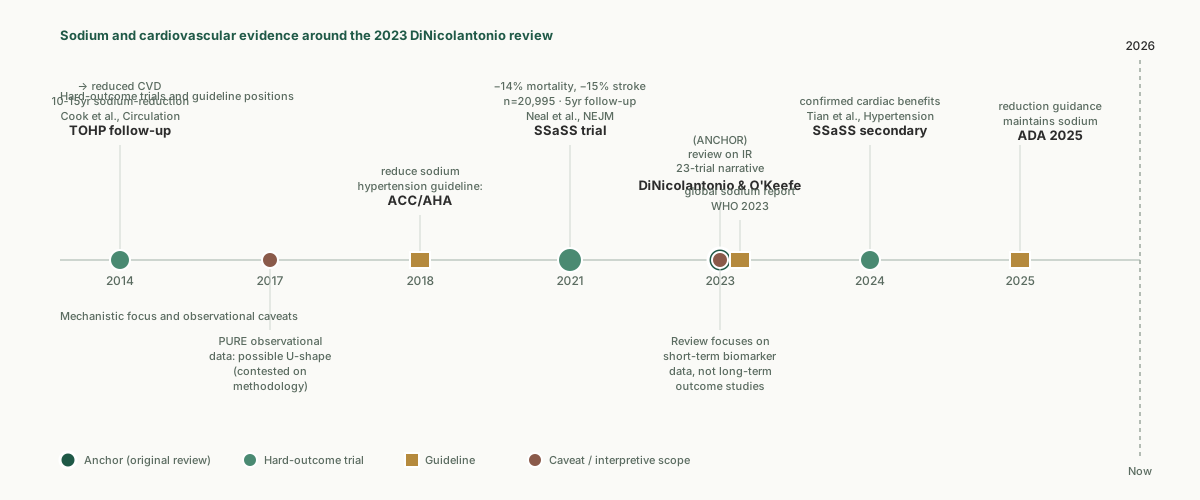
The clinical relevance of dietary potassium has gained prominence alongside the sodium discussion. Higher potassium intake is consistently associated with reduced blood pressure and reduced cardiovascular event rates. The Salt Substitute and Stroke Study (SSaSS) provided the strongest evidence for this in 2021, demonstrating that simply substituting 75% sodium chloride / 25% potassium chloride salt for regular table salt produced meaningful cardiovascular outcomes in a population of 20,995 adults followed for five years. The 2024 secondary analysis in Hypertension extended these findings to specific cardiac outcomes.
For patients with diabetes and metabolic disease specifically, the 2025 ADA Standards of Care (ElSayed et al., 2025) maintain sodium reduction recommendations consistent with the general AHA and WHO guidance, while also incorporating individualized nutritional approaches that account for patient-specific factors including baseline diet, kidney function, medication regimen, and overall cardiovascular risk profile.
What has been criticized or remains contested
The broader conclusion that “low-salt diets are harmful” pushes well beyond what the available long-term outcome evidence supports. The DiNicolantonio and O’Keefe review focused on mechanistic and short-term metabolic measures rather than on hard cardiovascular endpoints. The trials reviewed were typically short-duration, used severely restricted sodium intakes (often well below population-level recommendations), and measured biomarker responses rather than long-term disease incidence or mortality.
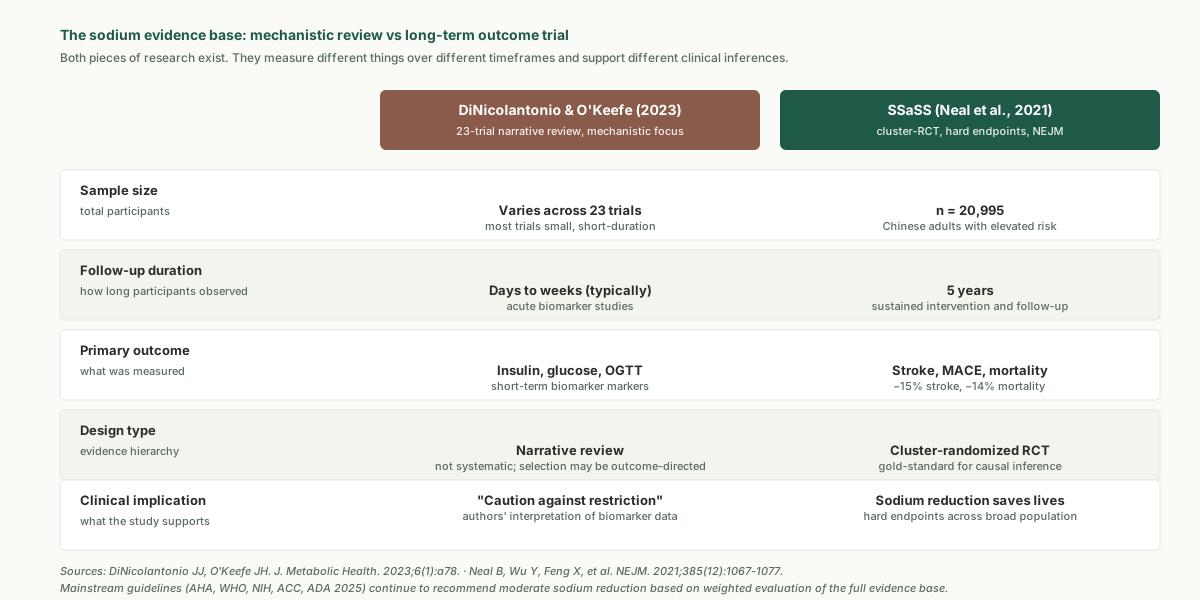
The strongest counter-evidence is the SSaSS trial (Neal et al., 2021), published in the New England Journal of Medicine. SSaSS was a cluster-randomized trial conducted in 20,995 Chinese adults with established stroke or hypertension, followed for an average of five years. Participants randomized to potassium-enriched salt substitute (75% NaCl / 25% KCl) experienced significant reductions in stroke (rate ratio 0.86), major adverse cardiovascular events (rate ratio 0.87), and all-cause mortality (rate ratio 0.88) compared with regular salt. The trial provides the strongest available RCT evidence that sodium reduction strategies produce measurable cardiovascular benefit at the level of hard clinical endpoints. The 2024 Hypertension secondary analysis extended the findings to specific cardiac event categories. SSaSS is not specifically a sodium-restriction trial (it tests potassium-enriched salt substitution) but the intervention produced both modestly reduced sodium and increased potassium intake, and the outcomes support the broader sodium-reduction framework.
The Trials of Hypertension Prevention (TOHP) follow-up studies provide additional long-term evidence. The original TOHP trials randomized adults to sodium reduction interventions and followed participants for 10-15 years post-trial. The follow-up analyses showed reduced cardiovascular event rates and reduced all-cause mortality in the sodium-reduction groups, with a dose-response relationship between sodium reduction and outcome improvement. These long-term outcome data are more clinically relevant than the short-term biomarker studies DiNicolantonio’s review emphasized.
The AHA, the ACC, the WHO, NIH, and major cardiology guideline bodies internationally continue to recommend reduced sodium intake (typically less than 2.0 to 2.3 grams per day for most adults) for cardiovascular risk reduction. The 2025 ADA Standards of Care maintain consistent sodium guidance. The institutional position has not shifted in the direction of DiNicolantonio’s framing despite the years of his public advocacy and the publication of his review. Guidelines bodies have reviewed essentially the same evidence and reached different conclusions, primarily because they weight long-term outcome data above short-term biomarker data.
The PURE study and its various follow-up analyses (Mente and colleagues, 2014-2024) raised observational evidence of a possible U-shaped relationship between sodium intake and cardiovascular outcomes, suggesting that both very low and very high sodium intakes might be associated with elevated risk. The PURE findings have been substantially contested on methodological grounds, particularly the use of single 24-hour urine collections to estimate habitual sodium intake. The PURE data have not changed major guideline positions, although they have contributed to ongoing scientific discussion about whether the lower bound of optimal sodium intake should be revisited.
DiNicolantonio’s broader public profile and contrarian sodium framing are part of a pattern that warrants weighing alongside the specific peer-reviewed work. The pattern of selecting biomarker-level evidence supportive of contrarian conclusions, while underweighting long-term outcome evidence pointing in the opposite direction, is a recurring feature of contrarian nutrition publishing. The 23-trial review is real research; the conclusion the authors drew from those trials reflects an interpretive framing that other researchers reviewing the same evidence base have not reached.
The review’s methodology has structural limitations worth noting. The selection of 23 studies showing “negative harms on insulin or glucose” describes a search strategy that may have been outcome-selective rather than comprehensive. A complete systematic review of the sodium-and-insulin literature would include studies showing neutral or beneficial effects of sodium reduction. The DiNicolantonio review acknowledged its narrative review structure but did not employ the systematic review methodology that would be standard for drawing strong clinical conclusions about treatment recommendations.
What this means for readers in 2026
The honest framing in 2026 is that mainstream sodium guidance remains supported by the strongest available evidence.
If you are evaluating dietary sodium guidance for general cardiovascular health, the consensus position from the AHA, WHO, NIH, and ACC supports moderate sodium reduction (target less than 2.0 to 2.3 grams per day for most adults). The 2021 SSaSS trial in NEJM provides the strongest available RCT evidence for cardiovascular benefit from sodium-reduction strategies, and the consensus position has not shifted in response to DiNicolantonio’s contrarian framing. For most adults, following mainstream sodium guidance is supported by both the population-level outcome evidence and the major institutional positions.
If you have hypertension and your physician has recommended sodium reduction, the mechanistic concerns raised by DiNicolantonio and O’Keefe do not override the strong evidence supporting sodium reduction for blood pressure control. Some patients (older adults, Black adults, and those with specific blood pressure phenotypes) show particularly meaningful responses to sodium reduction. Continue working with your physician on the specific guidance appropriate for your blood pressure pattern.
If you have type 2 diabetes or metabolic syndrome and have heard concerns about sodium restriction worsening insulin resistance, discuss the specific recommendation with your physician. The 2025 ADA Standards of Care maintain sodium-reduction recommendations within the broader nutrition guidance for T2D management. Individual response varies, and the appropriate sodium target may differ across patients depending on baseline diet, kidney function, blood pressure, and other factors. The general framing that sodium reduction is harmful for diabetic patients is not supported by the available evidence at the population level.
If you are considering salt substitution with potassium-enriched products (75% NaCl / 25% KCl is the SSaSS formulation), the evidence supports this as a useful intervention for cardiovascular risk reduction in most adults. The exceptions are patients with chronic kidney disease, patients taking potassium-sparing diuretics, ACE inhibitors, or ARBs (where hyperkalemia risk increases), and patients with specific adrenal conditions. Discuss with your physician before substituting if you take blood pressure medications or have kidney disease.
If you are at the very low end of habitual sodium intake (less than 1.5 grams per day) without medical indication for severe restriction, you may be in the range where the metabolic concerns DiNicolantonio raises become relevant. Population-level guidance is not the same as individualized clinical guidance for outlier patterns. Most adults are at the high end of sodium intake (often 3-4 grams per day or more); reduction toward the recommended range is well-supported. Reduction below 1.5 grams per day without medical indication is not standard guidance and may have the metabolic effects DiNicolantonio’s review describes.
If you are encountering DiNicolantonio’s broader public commentary on sodium, statins, or other nutrition and cardiovascular topics, the pattern across his work is to push against mainstream consensus on multiple fronts. The 23-trial review on sodium and insulin is real peer-reviewed work that engages with real mechanistic evidence; the conclusions the authors draw from that evidence are part of a broader interpretive framework that other researchers reviewing the same evidence base have not adopted. Reading the specific peer-reviewed work on its own merits, while recognizing the broader framing pattern, is the appropriate approach.
The 2023 review captured a genuine mechanistic concern about how extreme acute sodium restriction affects insulin signaling. The concern is supported by physiological evidence. The clinical and public-health implication the authors drew from that mechanistic concern, that population sodium guidance is harmful, is not supported by the long-term outcome evidence and remains contested by major guideline bodies. The honest 2026 framing is that moderate sodium reduction remains the appropriate public-health recommendation, that individualized clinical sodium guidance is appropriate within that broader framework, and that the mechanistic research DiNicolantonio cites is one piece of a larger evidence base that points in a different direction than his review’s interpretive framing.
References
Cook, N. R., Appel, L. J., & Whelton, P. K. (2014). Lower Levels of Sodium Intake and Reduced Cardiovascular Risk. Circulation, 129(9), 981–989.
DiNicolantonio, J. J., & O’Keefe, J. H. (2023). Sodium restriction and insulin resistance: A review of 23 clinical trials. Journal of Metabolic Health (formerly Journal of Insulin Resistance), 6(1), a78. https://doi.org/10.4102/jir.v6i1.78
ElSayed, N. A., Aleppo, G., Bannuru, R. R., et al. (2025). Standards of Care in Diabetes—2025. Diabetes Care, 48(Suppl 1).
Mente, A., O’Donnell, M., & Yusuf, S. (2021). Sodium intake and health: what should we recommend based on the current evidence? Nutrients, 13(9), 3232.
Neal, B., Wu, Y., Feng, X., et al. (2021). Effect of Salt Substitution on Cardiovascular Events and Death. The New England Journal of Medicine, 385(12), 1067–1077.
Tian, M., Yuan, J., Yu, F., et al. (2024). Secondary Analysis of the Salt Substitute and Stroke Study (SSaSS): Effects of Potassium-Enriched Salt on Cardiac Outcomes. Hypertension, 81(6), 1224–1233.
Whelton, P. K., Carey, R. M., Aronow, W. S., et al. (2018). 2017 ACC/AHA/AAPA/ABC/ACPM/AGS/APhA/ASH/ASPC/NMA/PCNA Guideline for the Prevention, Detection, Evaluation, and Management of High Blood Pressure in Adults. Journal of the American College of Cardiology, 71(19), e127–e248.
World Health Organization. (2023). WHO global report on sodium intake reduction.