About the original commentary
Aseem Malhotra, Grant Schofield, and Robert H. Lustig (2018) published The science against sugar, alone, is insufficient in tackling the obesity and type 2 diabetes crises: We must also overcome opposition from vested interests as a commentary in the Journal of Insulin Resistance. The piece is available in full at the publisher’s site under a Creative Commons Attribution 4.0 license. It runs six pages and is classified as a commentary rather than original research.
The three authors come from distinct positions. Aseem Malhotra is a UK cardiologist with a substantial public profile in nutrition policy and a track record of high-visibility critiques of nutrition guidelines, including a contested history on statin safety claims. Grant Schofield is a public health researcher and professor at Auckland University of Technology’s Human Potential Centre, with academic work on physical activity, sleep, and metabolic health. Robert H. Lustig is a pediatric endocrinologist at the University of California, San Francisco, whose research and public communication on fructose metabolism and metabolic disease has been central to the past two decades of sugar-and-health discourse. Lustig’s 2009 lecture Sugar: The Bitter Truth established him as the most visible academic voice on the topic.
The commentary makes two main claims. The first is that documented industry influence on nutrition science is substantial, parallels tobacco-industry tactics, and continues to shape research funding, study design, and public guidance in ways that obscure clear evidence about sugar’s metabolic harms. The second is that the policy implication, that population-level sugar reduction through taxation, marketing restrictions, and labeling changes can produce measurable health benefits, is supported by the available evidence and worth pursuing despite industry opposition.
The commentary did not declare external funding. The authors disclosed their broader public positions in nutrition policy. The article has accumulated more than 61,000 views and was published in the same year that the UK Soft Drinks Industry Levy took effect, making it a contemporaneous policy argument rather than a retrospective evaluation.
What has been validated since publication
The historical evidence on sugar industry influence in nutrition research has been substantially documented and widely accepted. The foundational empirical work, which the commentary draws on, is Kearns, Schmidt, and Glantz (2016), published in JAMA Internal Medicine. The Kearns et al. analysis of internal Sugar Research Foundation documents showed that in the 1960s, the industry funded Harvard nutritionists Frederick Stare, Mark Hegsted, and Robert McGandy to produce a literature review that downplayed sucrose’s role in coronary heart disease and shifted attention toward dietary fat. The Sugar Research Foundation payment, equivalent to approximately $48,000 in 2016 dollars, was not disclosed in the resulting publications. The Kearns work has been widely cited in subsequent academic and policy discussions, and the broader historical parallel between sugar-industry and tobacco-industry research-influence tactics has been independently corroborated by other historical analyses of industry documents.
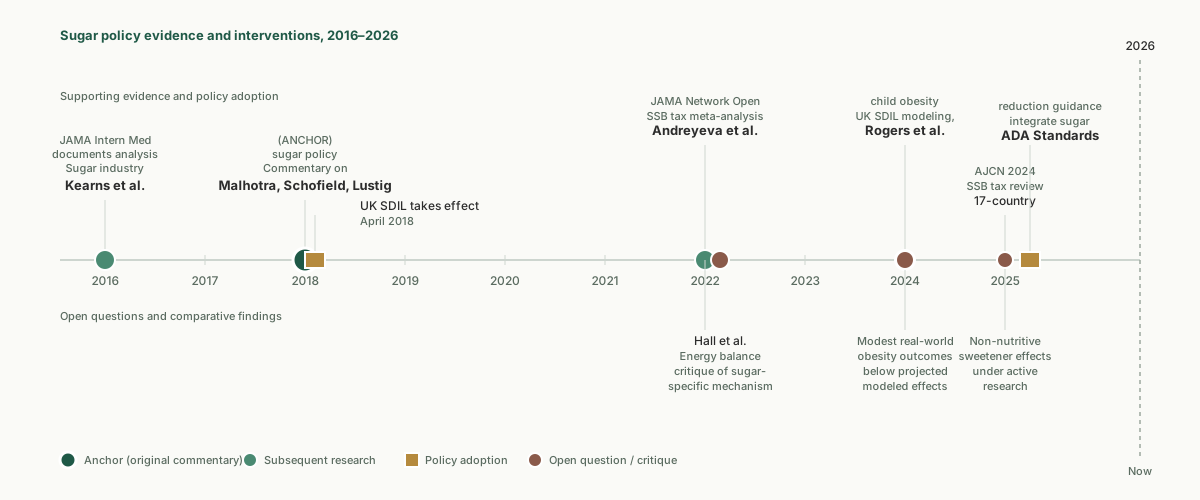
The natural experiment of sugar-sweetened beverage taxation has provided substantial new evidence in the years since the commentary was published. The UK Soft Drinks Industry Levy, implemented in April 2018, has been the subject of multiple peer-reviewed evaluations. Rogers, Cuffe, and colleagues (2024), publishing in PLOS Medicine, conducted an interrupted time series analysis combined with population health modeling on the SDIL’s effects in children and adolescents in England. The analysis projected substantial benefits from sustained implementation, including reductions in obesity prevalence and dental caries, with the largest benefits concentrated in younger age groups. Earlier interrupted time series work showed clear reductions in the sugar content of soft drinks following the levy’s implementation, driven primarily by industry reformulation rather than consumer substitution.
The broader international evidence base has expanded as more countries have implemented SSB taxes. Andreyeva and colleagues (2022), publishing in JAMA Network Open, conducted a systematic review and meta-analysis of SSB tax outcomes globally and documented consistent reductions in SSB purchases and price effects across implementations. A 2024 systematic scoping review in the American Journal of Clinical Nutrition examined national SSB taxation in 17 countries with taxes implemented in 2013 or earlier and found measurable reductions in SSB consumption, though the effects on population-level obesity and diabetes prevalence were more variable across settings.
The underlying biochemistry argument about fructose metabolism has held up. Lustig’s research program on hepatic fructose metabolism, de novo lipogenesis, and fructose’s distinct metabolic pathways relative to glucose remains active and is broadly accepted in pediatric endocrinology and hepatology. The connection between excess fructose consumption and non-alcoholic fatty liver disease in particular has accumulated substantial supporting evidence in the years since the commentary.
The 2025 ADA Standards of Care (ElSayed et al., 2025) and other major guideline updates have integrated sugar reduction more explicitly into diabetes prevention and management recommendations, reflecting the broader institutional acknowledgment that population-level dietary change is a legitimate target for both clinical and policy intervention.
What has been criticized or remains contested
The “sugar is uniquely metabolically harmful” claim, distinct from the broader “excess calories drive metabolic disease” claim, remains an active scientific debate. Kevin Hall and colleagues (2022), publishing in the American Journal of Clinical Nutrition, have argued that metabolic harms attributed to sugar in much of the research base are primarily mediated by total caloric excess and reward-driven overeating, rather than by mechanisms unique to sucrose or fructose. The Hall position is not that sugar is irrelevant but that the magnitude of sugar-specific effects, isolated from total energy intake, may be smaller than the carbohydrate-insulin model (Ludwig et al., 2021) and the Lustig framing imply. The debate has continued in Cell Metabolism, AJCN, and similar journals through 2025 (Ludwig et al., 2025) without resolution.
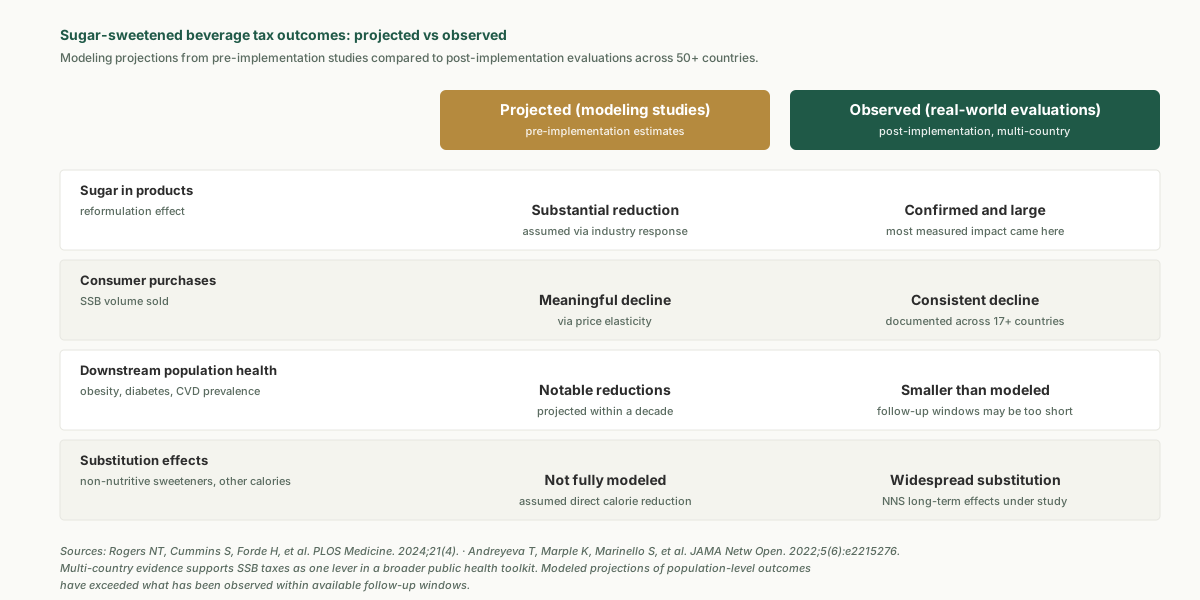
Real-world health outcomes from SSB taxes have been more modest than initial modeling projections suggested. While reductions in SSB purchases and industry reformulation are consistent and well-documented, measurable changes in population obesity prevalence, diabetes incidence, and cardiovascular outcomes within the available follow-up windows have been smaller and more variable than the population-health modeling studies projected. Several reasons may apply. Caloric substitution from other food sources may offset some of the SSB reduction. Industry reformulation has moved much of the affected market toward non-nutritive sweeteners, whose long-term metabolic effects remain a subject of active research. The follow-up windows may simply be too short to detect population-level body composition changes that develop over decades. Whatever the mechanism, the gap between projected and observed effects deserves attention when evaluating policy proposals.
The reformulation effect itself raises secondary questions. Most of the UK SDIL’s measured impact came through manufacturers reducing sugar in their products rather than consumers switching to lower-sugar alternatives. Non-nutritive sweeteners replaced sugar in many products. The long-term metabolic and microbiome effects of widespread non-nutritive sweetener substitution are themselves debated in the recent literature, including questions about glucose tolerance, gut microbiome composition, and cardiovascular outcomes raised by observational cohort studies and animal research over the past five years.
The broader rhetorical framing of the commentary, that vested interests are the principal barrier to evidence-based nutrition policy generally, is more contested than the specific evidence on sugar industry influence requires. The Kearns et al. (2016) documentation of sugar-industry tactics in the 1960s and 1970s is solid history. The extension of this framing to characterize current mainstream nutrition guidance and clinical practice as systematically captured by industry interests is a stronger and more contested claim. Aseem Malhotra’s broader public profile, including post-2020 statements on cardiovascular and COVID-19 topics, has prompted significant criticism of his broader pattern of framing mainstream medical practice as iatrogenic. The line between the well-documented historical claim about sugar industry influence and the broader rhetorical generalization matters for evaluating where the commentary’s argument lands today.
Other dietary and lifestyle drivers of metabolic disease, including ultra-processed food consumption, physical activity levels, sleep quality, alcohol intake, and environmental obesogens, have received increasing research attention since 2018. The 2025 metabolic disease research environment is increasingly multi-causal, with ultra-processed food intake in particular emerging as a distinct exposure that overlaps with but is not reducible to added sugar content. Treating sugar reduction as the single most important lever may have been a useful policy simplification in 2018 but is harder to sustain as the evidence on parallel drivers accumulates.
What this means for readers in 2026
The commentary’s clinical and policy implications have aged in nuanced ways.
If you are evaluating the historical record of sugar industry influence on nutrition research, the Kearns et al. (2016) JAMA Internal Medicine documentation is solid history. Industry influence on nutrition science in the mid-twentieth century is well-established. The parallel to tobacco industry tactics is a reasonable framing of the documented evidence. This is part of why current research integrity standards in nutrition emphasize funding disclosure, pre-registration, and conflict-of-interest reporting more rigorously than in earlier eras.
If you are thinking about sugar reduction in your own diet or your family’s, the practical conclusion is straightforward and broadly agreed across mainstream nutrition guidance and the metabolic-health community. Reducing added sugars, particularly from sugar-sweetened beverages, is good public health advice with substantial supporting evidence. The 2025 ADA Standards of Care (ElSayed et al., 2025) and the WHO Dietary Guidelines both incorporate this recommendation. The point is non-controversial enough that mainstream and contrarian-metabolic-health communities largely agree on it.
If you are evaluating sugar-sweetened beverage taxes as a policy lever, the evidence supports modest real-world effects on consumption and industry reformulation, with smaller-than-projected effects on population-level disease prevalence within available follow-up windows. SSB taxes appear to be one useful intervention in a broader public health toolkit rather than a single decisive lever. The pattern of evidence is consistent enough that more than 50 countries have implemented some form of SSB taxation by 2025, while honest policy evaluation should not over-promise on the magnitude of expected health outcomes.
If you are reading Malhotra’s broader public commentary on nutrition policy, medical industry capture, or related topics, the commentary’s collaboration with Lustig (whose academic profile is more mainstream) and Schofield (whose academic work is well-regarded) does not extend to Malhotra’s full broader catalog of public claims. The well-supported historical claim about sugar industry influence is consistent with mainstream history of science. The broader generalization about industry capture across medicine is more contested. Reading the specific evidence on its own merits is the appropriate approach.
If you are working in clinical practice or public health policy, the takeaway closest to the consensus position is that added sugar reduction is a legitimate population-level health goal, that SSB taxation is one valid intervention among several with documented partial effectiveness, and that the broader challenge of metabolic disease prevention requires multiple parallel interventions including changes to food environment, physical activity infrastructure, and clinical care for established disease. The commentary’s emphasis on sugar policy as a single high-leverage intervention has aged as one component of a broader strategy rather than a stand-alone solution.
The 2018 commentary captured a real moment in the policy debate. The UK SDIL was about to take effect. The Kearns et al. industry-influence documentation was fresh. Lustig’s work on fructose was in its strongest scientific position. Eight years later, the historical and biochemistry pieces of the argument have held up. The policy effects have been real but more modest than initially projected. The broader rhetorical framing about vested interests across medicine generally requires more careful reading than the specific evidence on sugar policy supports.
References
Andreyeva, T., Marple, K., Marinello, S., Moore, T. E., & Powell, L. M. (2022). Outcomes Following Taxation of Sugar-Sweetened Beverages: A Systematic Review and Meta-analysis. JAMA Network Open, 5(6), e2215276.
ElSayed, N. A., Aleppo, G., Bannuru, R. R., et al. (2025). Standards of Care in Diabetes—2025. Diabetes Care, 48(Suppl 1).
Hall, K. D., Farooqi, I. S., Friedman, J. M., et al. (2022). The energy balance model of obesity: beyond calories in, calories out. The American Journal of Clinical Nutrition, 115(5), 1243–1254.
Kearns, C. E., Schmidt, L. A., & Glantz, S. A. (2016). Sugar industry and coronary heart disease research: a historical analysis of internal industry documents. JAMA Internal Medicine, 176(11), 1680–1685.
Ludwig, D. S., Aronne, L. J., Astrup, A., et al. (2021). The carbohydrate-insulin model: a physiological perspective on the obesity pandemic. The American Journal of Clinical Nutrition, 114(6), 1873–1885.
Ludwig, D. S., Ebbeling, C. B., Apovian, C. M., et al. (2025). Testing the carbohydrate-insulin model: The data are supportive! Cell Metabolism.
Malhotra, A., Schofield, G., & Lustig, R. H. (2018). The science against sugar, alone, is insufficient in tackling the obesity and type 2 diabetes crises. Journal of Insulin Resistance, 3(1), a39. https://doi.org/10.4102/jir.v3i1.39
Rogers, N. T., Cummins, S., Forde, H., et al. (2024). Impact of the UK soft drinks industry levy on health and health inequalities in children and adolescents in England: An interrupted time series analysis and population health modelling study. PLOS Medicine, 21(4).