About the original paper
Ryan P. Lowery, Jacob M. Wilson, Andrew Barninger, Matthew H. Sharp, Christopher Irvin, Matthew Stefan, William A. Wallace, Gabriel J. Wilson, Michael D. Roberts, and Ronald Wagner (2018a) published The effects of soluble corn fibre and isomaltooligosaccharides on blood glucose, insulin, digestion and fermentation in healthy young males and females in the Journal of Insulin Resistance. The paper is available in full at the publisher’s site under a Creative Commons Attribution 4.0 license.
The lead author and most coauthors were affiliated with the Applied Science and Performance Institute, a commercial sports nutrition research organization, and with Concordia University Chicago. Gabriel J. Wilson was affiliated with Maximum Human Performance, a commercial supplement company. Michael D. Roberts was at Auburn University. The combination of academic and commercial affiliations is common in fibre and supplement research; the affiliation pattern is worth noting because the broader category of research on novel fibre ingredients tends to be funded by ingredient manufacturers seeking favorable findings to support product labeling and marketing claims. The paper did not declare external funding in the original text, but the affiliation pattern suggests commercial interest in the outcomes.
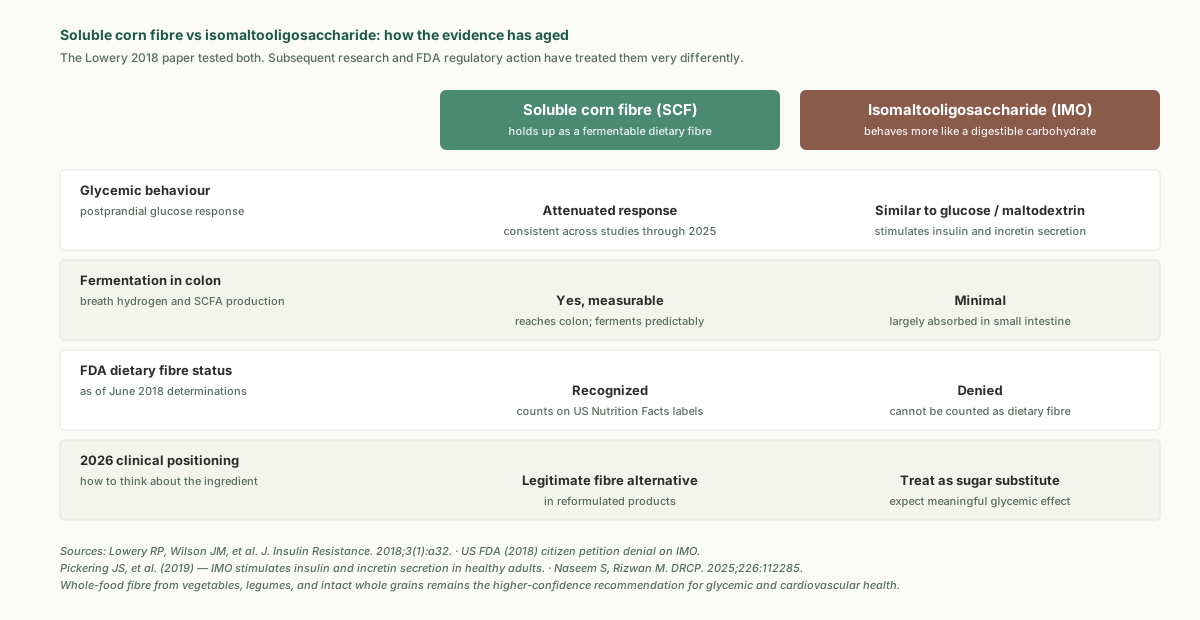
The study compared three treatments in healthy young adults: a SCF beverage, an IMO beverage, and a control. Measurements included postprandial glucose, insulin, breath hydrogen (an indirect marker of fermentation by colonic bacteria), and self-reported gastrointestinal tolerance over the hours following ingestion. The headline findings were that SCF produced lower glycemic and insulin responses than IMO, that breath hydrogen rose with SCF in a pattern consistent with fermentable fibre reaching the colon, and that GI tolerance was generally good with both fibres in the doses tested.
A corrigendum was issued by AOSIS Finalisation and Publishing three months after the original publication (Lowery et al., 2018b). The corrigendum is a one-page correction notice listing changes to the original article. Readers consulting the original paper should be aware that the version of record incorporates the corrigendum’s corrections.
The article has accumulated more than 19,000 abstract views and has been cited in subsequent peer-reviewed work on IMO and gut hormone effects (Naseem & Rizwan, 2025).
What has been validated since publication
The SCF portion of the original finding has aged better than the IMO portion. Subsequent research has generally supported the broader claim that soluble corn fibre attenuates postprandial glycemic and insulin responses when substituted for digestible carbohydrate. A 2020 review examined the broader literature on soluble corn fibre and confirmed a consistent pattern of reduced glycemic and insulin response across multiple studies in healthy and metabolically compromised populations, with breath hydrogen and gastrointestinal tolerance findings broadly consistent with the Lowery study.
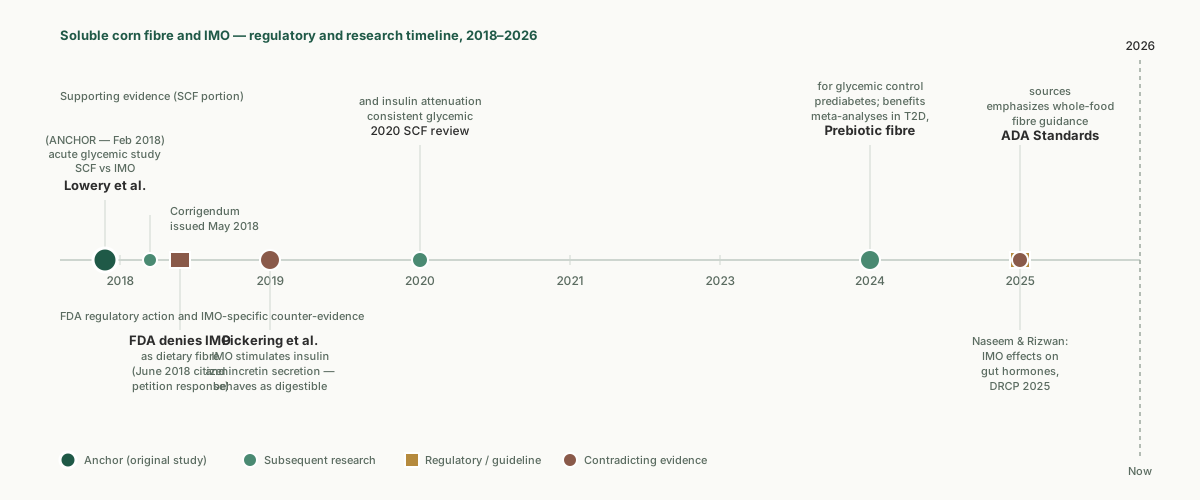
The broader dietary fibre literature has accumulated substantial evidence supporting the metabolic benefits of fermentable fibres in glucose-impaired populations. Recent meta-analyses on prebiotic fibre interventions show meaningful benefits on glycemic control in prediabetes and type 2 diabetes (multiple 2024-2025 systematic reviews). The general principle that fermentable fibres support metabolic health through short-chain fatty acid production, gut microbiome modulation, and reduced postprandial glycemic excursions is now well-established in nutrition science.
The 2025 ADA Standards of Care (ElSayed et al., 2025) incorporate dietary fibre recommendations into T2D and prediabetes management. The institutional position on fibre as a category is supportive, though specific recommendations focus on whole-food sources (vegetables, legumes, whole grains) rather than isolated fibre ingredients added to processed foods.
What has been criticized or remains contested
The IMO portion of the original finding has been substantially contested by both subsequent research and regulatory determination. In June 2018, three months after the Lowery paper was published, the FDA denied a citizen petition to add IMO to the list of non-digestible carbohydrates that meet the dietary fibre definition (US FDA, 2018). The Agency concluded that the available scientific evidence did not demonstrate a beneficial physiological effect of the kind required by the dietary fibre definition under the updated nutrition labeling regulations. The FDA’s denial means that IMO cannot be counted as dietary fibre on US Nutrition Facts labels, a meaningful regulatory and commercial outcome for the product category the original paper studied.
Subsequent research has provided mechanistic support for the FDA’s regulatory position. Pickering and colleagues (2019) reported that IMO ingestion stimulates insulin and incretin hormone secretion in healthy adults in a pattern consistent with digestible carbohydrate absorption, not with fermentable fibre behaviour. Additional studies have found that IMO produces glycemic and insulin responses similar to glucose or maltodextrin reference controls, supporting the interpretation that IMO is largely digested in the small intestine rather than reaching the colon for fermentation. The Lowery study’s framing of IMO as a fibre alternative was reasonable based on the limited data available in early 2018, but the subsequent regulatory and mechanistic evidence has not supported that framing.
The industry-adjacent affiliation pattern matters when interpreting the original paper. The Applied Science and Performance Institute is a commercial research organization. Maximum Human Performance is a supplement company. Fibre ingredient manufacturers (Tate & Lyle for soluble corn fibre, BioNeutra for IMO) had clear commercial interests in research demonstrating beneficial physiological effects of these ingredients, since the dietary fibre label allowed by FDA regulation drives substantial product reformulation revenue. The original paper did not declare specific funding, but the affiliation pattern is typical of industry-adjacent research where the broader research program is enabled by industry funding even when specific studies are not directly sponsored.
The single-meal acute study design limits the conclusions to short-term postprandial response in healthy adults. The original paper made no claims about chronic effects, T2D management, weight loss, or other downstream outcomes. Readers encountering this research in popular contexts, including in low-carbohydrate and ketogenic communities where SCF is sometimes promoted as a low-glycemic sweetener alternative, should not over-extrapolate from a short-duration healthy-volunteer study to long-term metabolic outcomes.
The corrigendum issued three months after publication, while a normal part of scientific quality control, is worth noting for readers consulting the original. The corrigendum’s existence does not invalidate the underlying findings but does mean that any analysis of the original paper should incorporate the corrected version.
What this means for readers in 2026
The practical takeaways depend on the question you are asking.
If you are looking at IMO on a product label in a “fibre-fortified” food, the FDA’s 2018 denial of IMO as a dietary fibre means that products sold in the US cannot legally count IMO toward their dietary fibre content on Nutrition Facts labels. Some products may still list IMO under “ingredients” without claiming it as fibre. The available evidence supports the FDA’s position that IMO behaves more like a digestible carbohydrate than a fermentable fibre. For glycemic control purposes, treat IMO as a sugar substitute that may or may not affect your blood glucose substantially depending on the specific product and your individual response.
If you are considering soluble corn fibre in low-carbohydrate baked goods, protein bars, or other reformulated products, the available evidence supports the modest claim that SCF attenuates postprandial glycemic response compared with digestible carbohydrate. SCF retains its dietary fibre status under FDA regulation. Continuous glucose monitoring data, where available, can confirm individual response: some people see meaningful glycemic effects from SCF-containing products, others see less than the population-level data would predict.
If you have type 2 diabetes or prediabetes and are evaluating whether to incorporate isolated fibre supplements into your management plan, the evidence base supports fibre intake from whole-food sources (vegetables, legumes, intact whole grains) more strongly than from isolated fibre ingredients added to processed foods. The 2025 ADA Standards of Care reflect this distinction. Specific fibre supplements may have a role, but they are not a substitute for the broader dietary pattern.
If you are evaluating fibre claims on supplement or sports nutrition products, the broader principle is that the dietary fibre regulatory category in the US has been tightened since 2018. Several non-digestible carbohydrates that were previously labeled as fibre were removed from the FDA list after the 2018 regulatory determinations. Products formulated before the changes may use language that no longer matches current regulatory definitions. Read labels with awareness that “added fibre” claims can refer to a variety of ingredients with different physiological effects.
If you are interpreting industry-adjacent nutrition research generally, the Lowery paper is a useful example. Studies authored by researchers at commercial performance-nutrition organizations, on ingredients with substantial commercial interest, deserve the same evidence-quality scrutiny as any other research. The findings may still be valid, but the context warrants additional caution about generalization, dose-response, real-world applicability, and the gap between supportive single-study findings and the broader evidence base needed to establish clinical claims.
The 2018 study captured a moment when fibre ingredient manufacturers were testing the boundaries of FDA dietary fibre regulation through industry-adjacent research and citizen petitions. The FDA’s mid-2018 regulatory determinations on IMO and several other ingredients tightened the boundary substantially. The Lowery paper sits inside that regulatory moment, with the SCF portion of the findings holding up better than the IMO portion. Eight years later, the practical effect is that careful readers should treat the paper as one piece of evidence in a regulatory and research environment that has moved meaningfully since publication.
References
ElSayed, N. A., Aleppo, G., Bannuru, R. R., et al. (2025). Standards of Care in Diabetes—2025. Diabetes Care, 48(Suppl 1).
Lowery, R. P., Wilson, J. M., Barninger, A., Sharp, M. H., Irvin, C., Stefan, M., Wallace, W. A., Wilson, G. J., Roberts, M. D., & Wagner, R. (2018a). The effects of soluble corn fibre and isomaltooligosaccharides on blood glucose, insulin, digestion and fermentation in healthy young males and females. Journal of Insulin Resistance, 3(1), a32. https://doi.org/10.4102/jir.v3i1.32
Lowery, R. P., Wilson, J. M., Barninger, A., et al. (2018b). Corrigendum: The effects of soluble corn fibre and isomaltooligosaccharides on blood glucose, insulin, digestion and fermentation in healthy young males and females. Journal of Insulin Resistance, 3(1), a35. https://doi.org/10.4102/jir.v3i1.35
Naseem, S., & Rizwan, M. (2025). IMO-induced changes in gut hormones and glucose metabolism: A key to improving insulin sensitivity in type 2 diabetes. Diabetes Research and Clinical Practice, 226, 112285.
Pickering, J. S., et al. (2019). Ingestion of isomalto-oligosaccharides stimulates insulin and incretin hormone secretion in healthy adults.
US Food and Drug Administration. (2018). FDA Issues Guidance, Science Review, and Citizen Petition Responses on Dietary Fiber. Citizen petition response denying isomaltooligosaccharide (IMO) as a dietary fibre.