About the original paper
Aseem Malhotra (2022) published Curing the pandemic of misinformation on COVID-19 mRNA vaccines through real evidence-based medicine — Part 1 in the Journal of Insulin Resistance (now Journal of Metabolic Health). The paper is available in full at the publisher’s site under a Creative Commons Attribution 4.0 license. It runs eight pages and is classified as a narrative review. Malhotra’s author affiliation in the paper is Public Health Collaboration, London, United Kingdom — an organization he co-founded, distinct from his clinical NHS affiliations.
The paper has accumulated nearly 287,000 abstract views and over 306,000 full article views — by a substantial margin the most-read article in the Journal of Insulin Resistance / Journal of Metabolic Health archive. The article has eight Crossref citations as of 2026, including several papers in adjacent COVID-policy literature, the companion Part 2, and a 2024 paper in Cureus on nudging ethics in COVID communication.
The paper’s argument has several specific components.
First, on the risk-benefit math: the author argues that in non-elderly populations, the “number needed to treat” or “number needed to vaccinate” to prevent a single COVID-19 death runs into the thousands, and that this framing was not communicated transparently to patients receiving the vaccines. The argument draws on age-stratified mortality risk data and trial efficacy estimates.
Second, on the adverse event evidence: the paper relies heavily on a re-analysis by Fraiman, Doshi, Erviti, Jones, Greenland, Whelan, and Kaplan, published in Vaccine in September 2022. That re-analysis used the Brighton Collaboration list of serious adverse events of special interest and reported an excess risk in vaccine recipients of approximately 12.5 per 10,000 vaccinated — exceeding the rate of COVID-19 hospitalization in the same trial populations. Malhotra cites this work as evidence that serious adverse events from vaccination may exceed the benefit in low-risk populations.
Third, on cardiovascular safety: the paper documents a rise in cardiac arrest emergency calls to ambulances in England during 2021, alongside reported Israeli data showing similar patterns in 16-39-year-olds. The author proposes a temporal association with vaccine rollout and identifies plausible mechanistic pathways including vaccine-induced myocarditis and other cardiovascular adverse events.
Fourth, on informed consent: the paper argues that consent to receive the vaccines was not fully informed because adverse event information and risk-benefit data were not adequately communicated, and concludes by calling for a pause and reappraisal of global vaccination policies.
The author group’s broader public profile is relevant context for the work. Aseem Malhotra is a UK cardiologist with substantial public profile in cardiovascular and nutrition advocacy. Earlier in his career, he advanced contested claims about statin safety that were withdrawn after the underlying observational data were found to be flawed. Following the publication of this paper and his subsequent public advocacy, the UK General Medical Council received complaints in January 2023 from a group of doctors, including Dr. Matt Kneale, requesting investigation into his fitness to practice based on COVID-19 vaccine claims. The GMC initially closed the concerns under Rule 12. After judicial review proceedings, the GMC acknowledged in 2024 that it had made an error in the Rule 12 decision-making process and reopened the case for further review. As of 2026, fitness-to-practice proceedings are ongoing. Malhotra has also been the subject of critical commentary in mainstream venues including The Lancet’s “Offline” column and detailed fact-checking by Science Feedback. None of this regulatory or critical context invalidates the specific peer-reviewed claims in the 2022 paper, but it represents the broader interpretive frame in which the work sits.
The paper did not declare external funding. The author disclosed his public positions in COVID-19 policy advocacy.
What has been validated since publication
Several specific concerns the paper raised have been substantially validated by subsequent peer-reviewed evidence and policy changes.
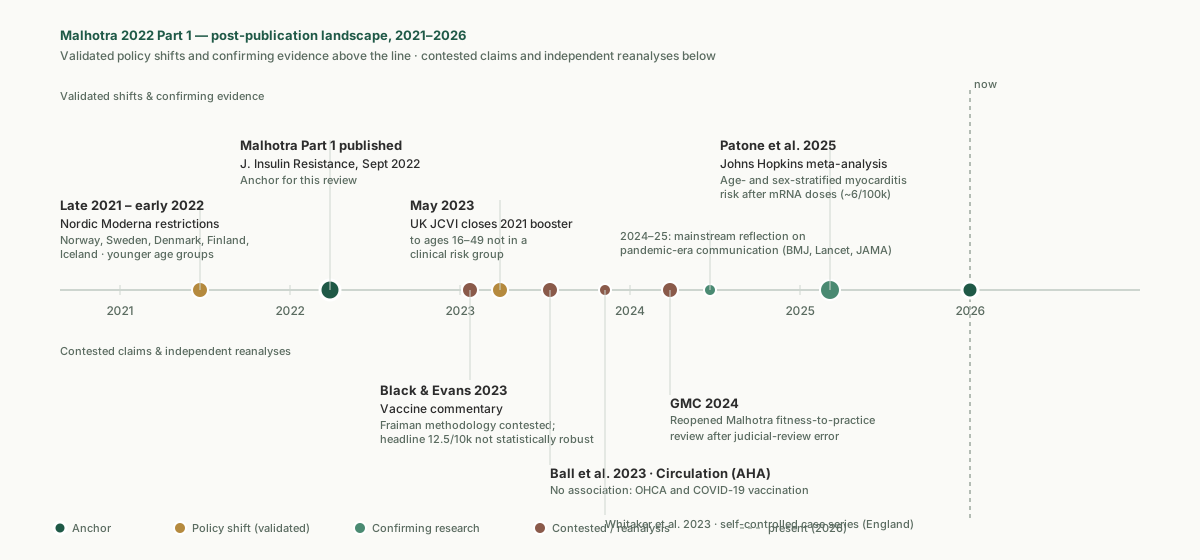
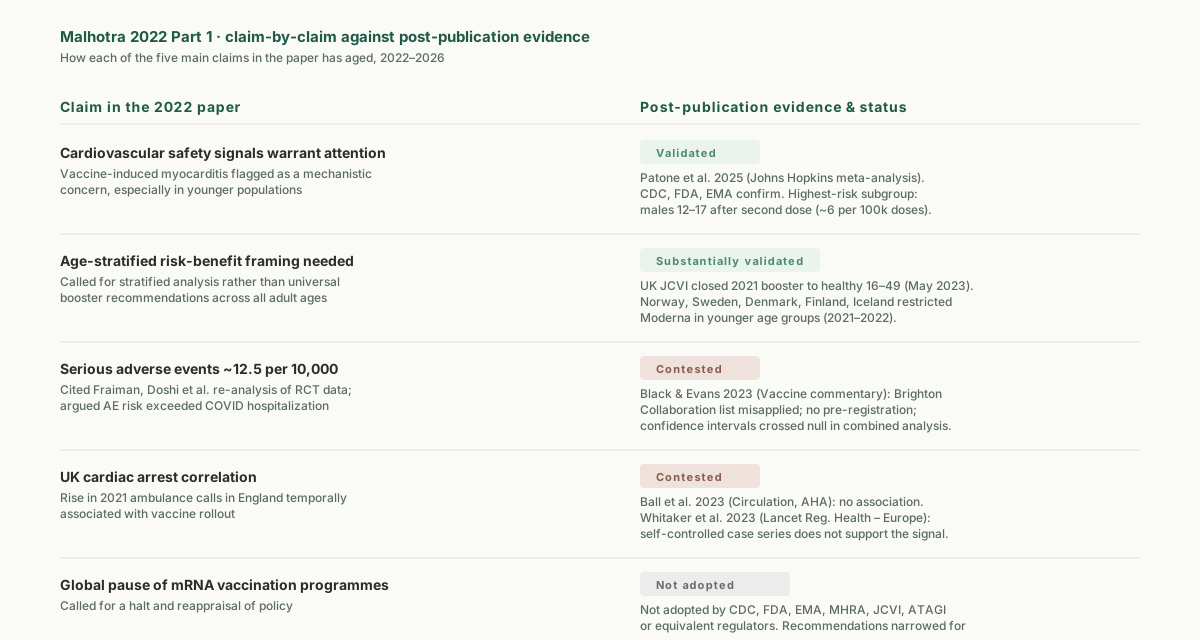
The myocarditis signal in young males after mRNA second doses is now established and uncontroversial across mainstream medical bodies. The 2025 systematic review and meta-analysis from Johns Hopkins University (Patone et al., 2025) examined age- and sex-stratified risks of myocarditis and pericarditis attributable to COVID-19 vaccination, confirming an elevated risk concentrated in young males, particularly after the second mRNA dose. The highest-risk subgroup — males aged 12-17 after the second dose — shows approximately 6 cases per 100,000 doses. The CDC, FDA, EMA, and major journal-published meta-analyses have all confirmed the signal. This validates the broader claim Malhotra made that cardiovascular safety signals warranted attention, even where the specific evidence he drew on to make that argument (discussed in the contested section below) did not hold up.
The age-stratified risk-benefit framing the paper argued for has been substantially incorporated into mainstream policy. In May 2023, the UK Joint Committee on Vaccination and Immunisation closed the 2021 COVID-19 booster vaccination offer to people aged 16-49 not in a clinical risk group, on the basis that the risk-benefit math for younger healthy populations no longer supported routine boosting given lower disease burden and durable vaccine-induced and infection-acquired protection. Norway restricted Moderna to men over 30 in October 2021 and to women under 30 in January 2022, citing cardiovascular safety considerations. Sweden restricted Moderna to residents 30 and over in October 2021. Denmark, Finland, and Iceland took comparable steps.
The picture in the United States is different and less clean-cut. The Centers for Disease Control and Prevention’s Advisory Committee on Immunization Practices (ACIP) has not restricted mRNA vaccines by age or product in the way the Nordic authorities did. What ACIP did do, in stages between 2022 and 2025, was move from a universal-booster recommendation for all adults toward more nuanced “shared clinical decision-making” language for lower-risk younger populations, with routine annual boosting still recommended for higher-risk groups (65+, immunocompromised, significant comorbidities). More recent U.S. guidance changes under the current HHS leadership have further narrowed the routine recommendation, though those changes have been politically contested rather than driven primarily by the age-stratified safety data that drove the European decisions. The net effect is that U.S. guidance for younger healthy adults has moved in a broadly similar direction to the European examples above, but the reasoning trail and the level of political controversy around the changes are distinct.
The 2025 mainstream medical consensus on COVID-19 boosting in young healthy adults is meaningfully more stratified than the 2021 universal-booster framing the paper was responding to.
The “number needed to vaccinate” framing — and more broadly the call for stratified risk-benefit analysis rather than universal recommendations — has become more mainstream in subsequent literature. The original Fraiman, Doshi, et al. (2022) paper that Malhotra cites was peer-reviewed in Vaccine and has been substantially cited in subsequent risk-benefit discussions. The methodology of that paper is contested (addressed below in the contested section), but the broader call for transparent stratified risk-benefit analysis aligns with where mainstream policy thinking has moved.
The clinical trial data transparency question has been partially addressed in the years since publication. FOIA-released Pfizer trial documents have continued to be made available through court order. Subsequent re-analyses of trial data have appeared in peer-reviewed venues. Whether the underlying trial data were sufficiently transparent during the original vaccine rollout remains a separate scientific and ethical question; the post-rollout availability of more granular data has improved.
The broader recognition that initial public health communication during 2020-2022 was, in retrospect, too confident in some specific claims has become more mainstream in 2024-2025. Multiple reflections in BMJ, The Lancet, JAMA, and other major journals have engaged with how scientific uncertainty was communicated, where messaging overshot the evidence base, and how trust in public health institutions was affected. The broader meta-conversation about pandemic-era public health communication is real, and parts of Malhotra’s framing — that informed consent requires honest acknowledgment of uncertainty — have aged into mainstream commentary.
What has been criticized or remains contested
The methodology of the Fraiman, Doshi, et al. (2022) re-analysis that the paper relies on was directly contested in the same journal. Black and Evans (2023) published a formal commentary in Vaccine identifying specific methodological concerns: the use of the Brighton Collaboration adverse-event-of-special-interest list as a screening tool when it was designed for surveillance rather than primary outcome ascertainment; the absence of pre-registered hypotheses; and confidence intervals that in the combined analysis crossed the null, meaning the headline 12.5 per 10,000 figure was not statistically robust at conventional thresholds. The Fraiman paper itself is real, peer-reviewed, and remains in the literature; the question is whether its specific methodology supports the strong conclusions Malhotra drew from it. Black and Evans argue it does not.
The UK cardiac arrest correlation has not held up under independent scrutiny, and given how central it is to the paper’s cardiovascular safety argument, it warrants a closer look at who did the follow-up work and what they found.
The core of the follow-up analysis has come from three types of independent sources. The first is the American Heart Association’s flagship journal Circulation, which in 2023 published Ball et al., “No Association Between Out-of-Hospital Cardiac Arrest and COVID-19 Vaccination” — an analysis using population-level cardiac arrest registry data across pre-pandemic, pandemic-pre-vaccine, and pandemic-with-vaccine time periods. The analysis found no variation in monthly rates of out-of-hospital cardiac arrest, myocarditis-caused cardiac arrest, or unascertained cardiac arrest by time period, and no correlation with vaccine rollout timing. The second is peer-reviewed work in Resuscitation and the European Heart Journal by cardiac-arrest researchers using registry data from the UK OHCAO (Out-of-Hospital Cardiac Arrest Outcomes) programme run through the Warwick Clinical Trials Unit, which showed that OHCA incidence during 2020-2021 tracked COVID-19 case incidence, not vaccine rollout timing. The third is a self-controlled case series analysis published in The Lancet Regional Health – Europe examining cardiac arrhythmia and cardiac arrest risk after primary and booster COVID-19 vaccination in England (Whitaker et al., 2023), which used a case-only design to control for time-invariant confounders and did not find the population-level cardiac arrest signal Malhotra’s original correlation implied.
The confounders these analyses were built to address are substantial. COVID-19 infection itself substantially increases cardiovascular event risk. The pandemic produced widespread deferral of routine cardiovascular care, including elective interventions for chronic conditions. Lockdown changed emergency response patterns; ambulance dispatch protocols were modified under the pressure of pandemic-era demand. Any raw correlation between 2021 ambulance calls and 2021 vaccine doses inherits all three of these confounders. Once they are accounted for using registry data and analytic methods designed to isolate the vaccine signal specifically, the correlation Malhotra reported does not survive.
The mechanism Malhotra invoked (myocarditis-mediated cardiac events at population scale) is also implausible at the magnitude that would explain the ambulance call data. The confirmed rate of clinically significant myocarditis post-vaccination is on the order of 6 cases per 100,000 doses in the highest-risk subgroup (males 12-17 after second dose), and most cases resolve without cardiac arrest. The arithmetic does not support attributing a population-level rise in cardiac arrest calls to myocarditis from vaccination. The correlation Malhotra reported has not generalized into a causal signal that mainstream cardiology epidemiology accepts.
The Israeli 16-39-year-old data Malhotra cites has been subject to similar reanalysis. The reanalysis by independent Israeli researchers, accounting for pandemic confounders, has not supported the strong vaccine-attribution interpretation in the original paper.
The “NNT runs into thousands” framing as evidence of unfavorable risk-benefit is contested on its own terms. The framing focuses on a specific endpoint — preventing a single death — while not engaging with secondary endpoints including hospitalization prevention, severity reduction, transmission impact during high-circulation periods, and downstream complications including long COVID. The choice of endpoint dramatically changes the NNT calculation. For elderly and immunocompromised populations the NNT is much smaller for the same endpoints. The framing is appropriate for arguing that universal vaccination of low-risk young adults requires more careful justification than it received in 2021; it is not appropriate as a general argument against COVID-19 vaccination across all populations and indications.
The call to halt mRNA vaccination has not been adopted by any major medical regulator. CDC, FDA, EMA, MHRA, JCVI, ATAGI, and equivalent bodies in major jurisdictions have adjusted recommendations (notably narrowing booster recommendations for younger healthy populations) without halting vaccination. The mainstream consensus position in 2026 continues to favor vaccination for elderly populations, immunocompromised populations, and individuals with significant comorbidities, with the specific recommendation for younger healthy adults more nuanced and varying by jurisdiction.
The author’s broader public profile warrants weighing alongside the specific claims. Aseem Malhotra has an established pattern of advancing contested medical claims — earlier on statins, subsequently on COVID-19 vaccines, and in adjacent areas. The earlier statin claims were withdrawn after being traced to flawed observational data. The current GMC fitness-to-practice proceedings, reopened in 2024 after judicial review, remain ongoing as of 2026. This pattern does not invalidate the specific peer-reviewed claims in the 2022 paper, but it represents context readers should weigh. The pattern of selecting biomarker-level and observational evidence supportive of contrarian conclusions, while underweighting countervailing evidence, is a recurring feature of contrarian medical publishing. The 2022 paper sits within that pattern.
The Science Feedback fact-checking of Malhotra’s broader public communication on COVID-19 vaccines identified multiple specific claims that were either unsupported by available evidence or misrepresented the cited sources. Richard Horton’s “Offline” column in The Lancet engaged critically with Malhotra’s broader pattern of publishing and public advocacy. These mainstream critical responses are part of the context in which the 2022 paper has been received.
The narrative review methodology — as opposed to systematic review with pre-registered protocols — limits the strength of conclusions that can be drawn from the original paper. Narrative reviews allow authors to organize a coherent argument from selected evidence, which is appropriate for opinion pieces and commentary but does not support the strong policy conclusions (“global vaccination policies must pause”) that the paper advanced. A formal systematic review of the same evidence base with PRISMA methodology would have produced a more defensible synthesis of where the evidence pointed.
What this means for readers in 2026
The honest 2026 framing is that the paper raised some concerns that were validated and shaped subsequent policy, alongside specific claims that did not hold up.
If you are elderly, immunocompromised, or have significant comorbidities that elevate your risk of serious COVID-19 outcomes, the mainstream medical consensus continues to favor COVID-19 vaccination, including current boosting. The risk-benefit math for these populations remains clearly favorable. The concerns Malhotra raised about young healthy populations do not apply directly to your situation, and the policy bodies that have adjusted booster recommendations have done so for younger healthy populations specifically, not for elderly or higher-risk populations.
If you are a young healthy adult, the risk-benefit math for COVID-19 vaccination, particularly for boosting beyond an initial series, is more nuanced than the 2021 universal-vaccination framing suggested. Multiple national policy bodies have explicitly narrowed booster recommendations for younger healthy populations. The myocarditis signal in young males after mRNA second doses is real and uncontroversial, though at population rates (approximately 6 cases per 100,000 doses in the highest-risk subgroup) that do not justify avoiding initial vaccination during periods of high disease burden. The current consensus in many jurisdictions is that ongoing boosting for healthy young adults is a personal decision discussed with your physician based on individual risk factors, exposure patterns, and preferences, rather than a universal recommendation.
If you are a young male considering or having received mRNA vaccination, the documented myocarditis signal is concentrated in the second dose and in males aged 12-30, with approximately 6 cases per 100,000 doses in the highest-risk subgroup (males 12-17). Most cases are mild and resolve. Severe outcomes have been documented but are rare. Discuss with your physician if you have concerns. The non-mRNA COVID-19 vaccines have a different adverse event profile and were used in some jurisdictions as alternatives for younger males.
If you have a history of myocarditis or pericarditis, vaccination decisions should be individualized in discussion with your physician, with attention to the specific history and current cardiovascular status. Major guidelines have addressed re-vaccination decisions in patients with prior post-vaccination myocarditis.
If you are evaluating Malhotra’s broader public communication through books, podcasts, or social media, the pattern of his advocacy includes claims that have been validated (the myocarditis signal, the age-stratified risk-benefit argument) and claims that have not (the UK cardiac arrest correlation, the strong “halt vaccination” call, his earlier statin safety claims). The GMC fitness-to-practice proceedings are ongoing and have not concluded as of 2026. Reading specific peer-reviewed work on its own merits, while recognizing the broader pattern, is the appropriate approach. The fact that some concerns have been validated does not mean all concerns are correct; the fact that some concerns were not validated does not invalidate the entire body of work.
If you are interested in the broader pandemic-era public health communication question that the paper raised, this is now a substantial area of mainstream medical commentary. BMJ, The Lancet, JAMA, and other major venues have published reflections on how scientific uncertainty was communicated during 2020-2022, where messaging overshot the evidence base, and how to rebuild public trust in health institutions. The conversation has moved beyond the combative us-versus-them framing of 2022 into more nuanced discussion that takes both the public health imperatives and the legitimate communication failures seriously.
The 2022 paper occupied a contested space in pandemic-era medical discourse. Some of its specific concerns were ahead of where mainstream policy would move. Others were not validated by subsequent evidence. The honest evaluation in 2026 requires distinguishing between the specific peer-reviewed claims that have aged well, those that have not, and the broader rhetorical framing that operates at a different evidentiary level. Reading the paper as a single coherent argument that is either entirely correct or entirely wrong oversimplifies the actual state of the post-publication evidence.
It is important to understand what this page is and is not evaluating. The entire discussion on this page is about the risk-benefit analysis of the COVID-19 mRNA vaccines specifically — the Pfizer-BioNTech (BNT162b2) and Moderna (mRNA-1273) products — as that risk-benefit analysis has been argued in the 2022 Malhotra paper and reassessed in the peer-reviewed literature since. It is not about vaccination in general, nor about COVID-19 disease severity itself, nor about other COVID-19 vaccine platforms (protein subunit, viral vector) whose adverse event profiles are distinct. Age-stratified policy shifts described above apply to the mRNA products; broader COVID-19 vaccination policy for elderly, immunocompromised, and high-risk populations remains supported across every major regulator.
References
Ball, J., Nehme, Z., Bernard, S., Stub, D., Stephenson, M., & Smith, K. (2023). No Association Between Out-of-Hospital Cardiac Arrest and COVID-19 Vaccination. Circulation, 147(17), 1360–1362.
Black, S., & Evans, S. (2023). Serious adverse events following mRNA vaccination in randomized trials in adults [commentary]. Vaccine, 41(23), 3473–3474.
Fraiman, J., Erviti, J., Jones, M., Greenland, S., Whelan, P., Kaplan, R. M., & Doshi, P. (2022). Serious adverse events of special interest following mRNA COVID-19 vaccination in randomized trials in adults. Vaccine, 40(40), 5798–5805.
General Medical Council. (2024). Statement on Judicial Review of our handling of complaints about Dr Aseem Malhotra. London: General Medical Council.
Horton, R. (2022). Offline: The distance between us. The Lancet, 400(10369), 2071.
Joint Committee on Vaccination and Immunisation. (2023). JCVI statement on the COVID-19 vaccination programme for 2023. London: UK Health Security Agency.
Malhotra, A. (2022). Curing the pandemic of misinformation on COVID-19 mRNA vaccines through real evidence-based medicine — Part 1. Journal of Insulin Resistance, 5(1), a71. https://doi.org/10.4102/jir.v5i1.71
Norwegian Institute of Public Health. (2021–2022). Updated guidance on Moderna mRNA-1273 vaccination in younger age groups. Oslo: Folkehelseinstituttet.
Patone, M., Mei, X. W., Handunnetthi, L., et al. (2025). Age- and sex-stratified risks of myocarditis and pericarditis attributable to COVID-19 vaccination: A systematic review and meta-analysis. Johns Hopkins University.
Science Feedback. (2022). Article by cardiologist Aseem Malhotra made unsupported claims about the benefits and risks of COVID-19 vaccination.
Whitaker, H. J., Tsang, R. S. M., Byford, R., Aspden, C., Button, E., et al. (2023). Risk of cardiac arrhythmia and cardiac arrest after primary and booster COVID-19 vaccination in England: A self-controlled case series analysis. The Lancet Regional Health – Europe, 36, 100786.